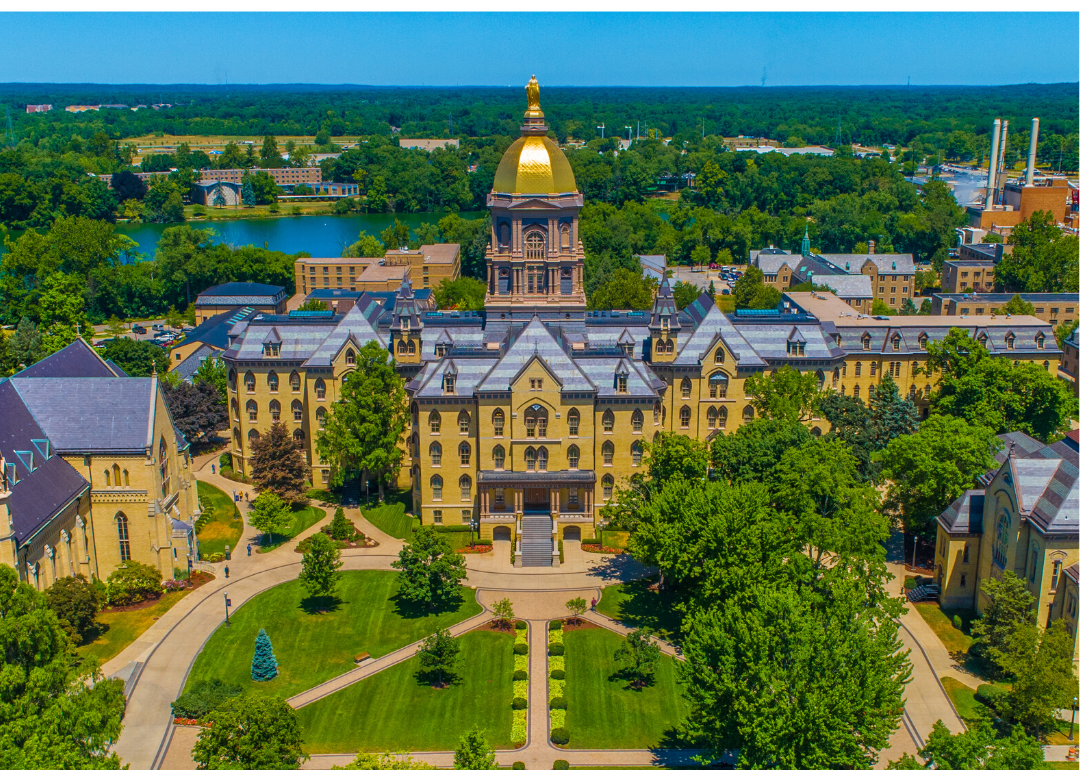
Best private colleges in America
Choosing a college can be one of the most important decisions in a person’s life. The universities that students attend will train them for their future careers, give them the education they need to think critically and solve real-world problems, and connect them to a lifelong social network and community. While invaluable, the benefits of higher education don’t come cheap—especially if the choice is a private school. Tuition and fees at private colleges clocked in at more than $35,000 a year on average in the 2018-2019 school year. That’s nearly four times as much as what a student would typically spend to attend an in-state public college, according to data from U.S. News & World Report. No wonder recent graduates of private nonprofit schools typically shoulder about $32,600 in student debt, according to Matt Carter of Credible.
The only way an investment in private college can potentially pay off is if students do their homework to find a school that fits their academic interests and social needs—which vary significantly from person to person. Some schools, like the University of San Diego and Bryn Mawr College, boast gorgeous campuses and idyllic settings to inspire learning. Other private colleges, like the Massachusetts Institute of Technology, offer phenomenal engineering and science programs to help students excel in competitive fields. While other institutions, like Whitman College, promise a well-rounded liberal arts education and endless opportunities to apply it to the issues students care about most.
To help narrow down options, Stacker compiled a list of the best private colleges in America, using data from Niche released in June. Niche ranks schools based on a variety of factors including academic, admissions, financial, and student life. Their methodology can be found here. We also used articles from news outlets and college profiles on Forbes, U.S. News & World Report, Money, and The Princeton Review to find out what attracts students to these universities, and how the institutions have been responding to the COVID-19 pandemic and the Black Lives Matter movement.
Whether you’re shopping around for colleges to potentially attend, or you want to see how your alma mater compares to its competitors, explore this list to see the 100 best private colleges in America.
You may also like: 100 highest paying jobs In America

#100. Loyola Marymount University
- Location: Los Angeles
- Students: 6,466
- Acceptance rate: 47%
- Graduation rate: 84%
- Faculty ratio: 10:1
- Six-year median earnings: $61,300
Loyola Marymount University offers a rigorous academic curriculum in the Jesuit tradition, which places a heavy emphasis on community service. As a result, students at this university complete more than 200,000 service hours every year.
#99. University of San Diego
- Location: San Diego
- Students: 5,678
- Acceptance rate: 53%
- Graduation rate: 80%
- Faculty ratio: 14:1
- Six-year median earnings: $60,000
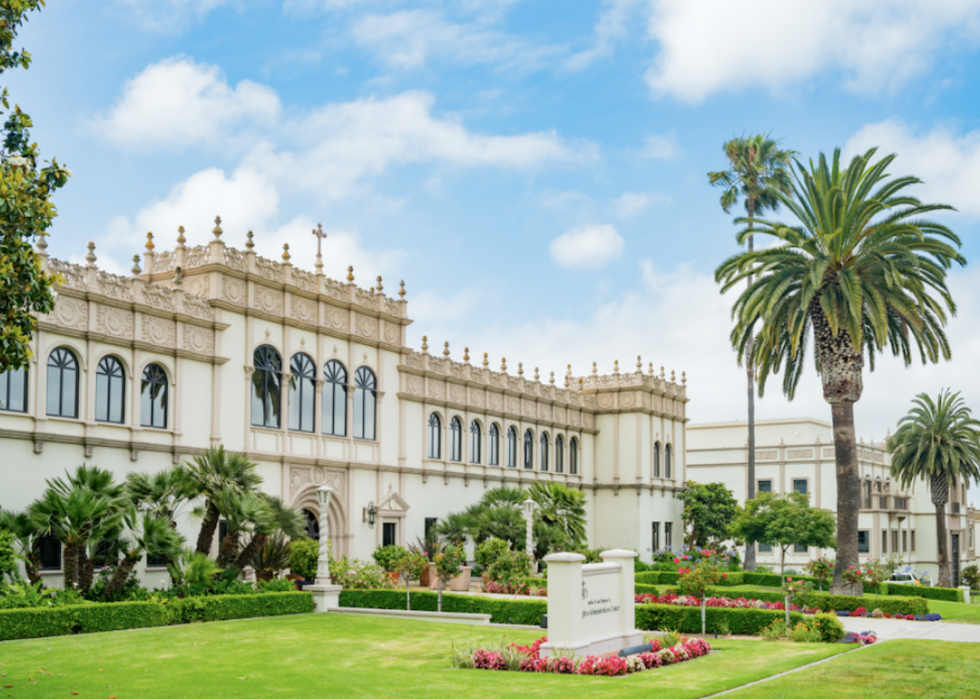
The University of San Diego is known for its stunning 180-acre campus that overlooks the city of San Diego and the Pacific Ocean, which provide a backdrop for the architecture of its Spanish Renaissance buildings. But despite the picturesque nature of the campus, USD students are eager to get away: More than two-thirds of the undergraduate student body participate in study abroad programs.

#98. Saint Louis University
- Location: St. Louis
- Students: 6,440
- Acceptance rate: 58%
- Graduation rate: 77%
- Faculty ratio: 9:1
- Six-year median earnings: $56,500
One of the oldest Catholic universities in the country, Saint Louis University has built a strong reputation as a research institution. Student research is an essential component for undergraduates and graduate students alike. The university provides opportunities for students to work side-by-side with faculty on important issues, including research related to COVID-19.

#97. Denison University
- Location: Granville, Ohio
- Students: 2,365
- Acceptance rate: 34%
- Graduation rate: 85%
- Faculty ratio: 9:1
- Six-year median earnings: $48,800
Denison University, a leading liberal arts college, is home to a wide range of extracurricular activities, including more than 160 clubs and organizations, 40 club and intramural sports, 24 varsity sports teams, and a student government with a budget of $1 million. Nearly all of its alumni have gotten jobs or continued their education in graduate school.

#96. Pepperdine University
- Location: Malibu, California
- Students: 3,336
- Acceptance rate: 36%
- Graduation rate: 83%
- Faculty ratio: 14:1
- Six-year median earnings: $65,500
Pepperdine University combines Christian values with a commitment to academic rigor. It has a beautiful, sustainability-focused campus with more than 500 of its 830 acres preserved in their natural state
You may also like: Ranking the reputation of the 100 most visible companies in America

#95. Syracuse University
- Location: Syracuse, New York
- Students: 14,655
- Acceptance rate: 50%
- Graduation rate: 83%
- Faculty ratio: 15:1
- Six-year median earnings: $62,100
Syracuse University, a private research university, has earned worldwide recognition for its college newspaper, journalism program, and special education training. It spoils students, providing them with a choice of more than 200 majors and 100 minors, along with 200 advanced degree programs.

#94. Bentley University
- Location: Waltham, Massachusetts
- Students: 4,185
- Acceptance rate: 43%
- Graduation rate: 89%
- Faculty ratio: 11:1
- Six-year median earnings: $86,900
A top business school, Bentley University prides itself on giving students the ethics they need to make a positive impact on the world throughout their careers. Within six months, 98% of the students who graduated in 2019 were employed, with an average salary of $60,000, or pursuing higher education.

#93. Wheaton College - Illinois
- Location: Wheaton, Illinois
- Students: 2,326
- Acceptance rate: 83%
- Graduation rate: 87%
- Faculty ratio: 10:1
- Six-year median earnings: $48,400
Wheaton College in Illinois has a large proportion of graduates who eventually earn doctorates. It’s considered one of the country’s premier Christian institutions.

#92. Furman University
- Location: Greenville, South Carolina
- Students: 2,665
- Acceptance rate: 61%
- Graduation rate: 80%
- Faculty ratio: 10:1
- Six-year median earnings: $51,200
Furman University ranks highly for both its academics and its campus culture. Every student is required to attend a minimum of 36 school events in order to graduate, as part of Furman’s Campus Life Program, according to U.S. News & World Report. The private college is home to Greek organizations and more than 200 clubs.

#91. Union College - New York
- Location: Schenectady, New York
- Students: 2,195
- Acceptance rate: 39%
- Graduation rate: 88%
- Faculty ratio: 10:1
- Six-year median earnings: $65,400
Students pursuing an education in the science, technology, engineering and mathematics (STEM) fields may want to consider Union College. It has one of the top 30 undergraduate engineering programs, receives a high amount of National Science Foundation grants, and is one of the top STEM schools for women.
You may also like: Best places to retire on the East Coast

#90. Franklin & Marshall College
- Location: Lancaster, Pennsylvania
- Students: 2,290
- Acceptance rate: 35%
- Graduation rate: 83%
- Faculty ratio: 9:1
- Six-year median earnings: $58,900
Franklin & Marshall College has proven that it quickly implements real-world issues into its teachings. This summer, it is offering two courses on the impact of COVID-19 policies. The college has a 9-to-1 student-to-faculty ratio, and 65% of students participate in research or individual educational opportunities guided by a faculty mentor.

#89. Texas Christian University
- Location: Fort Worth, Texas
- Students: 9,162
- Acceptance rate: 41%
- Graduation rate: 83%
- Faculty ratio: 13:1
- Six-year median earnings: $52,800
Texas Christian University is the largest higher education institutionassociated with the Christian Church (Disciples of Christ) denomination, but it accepts students of any faith, according to U.S. News & World Report. It has a huge Greek life scene on campus, and around 40% of all students participate in the fraternities or sororities.

#88. Yeshiva University
- Location: New York
- Students: 2,633
- Acceptance rate: 60%
- Graduation rate: 83%
- Faculty ratio: 7:1
- Six-year median earnings: $58,500
Yeshiva University is a Jewish school that includes three undergraduate colleges, each of which has its own campus in Manhattan. Students at the university spread their time between preprofessional studies, liberal arts and sciences, and studying the Torah and Jewish heritage.

#87. University of Tulsa
- Location: Tulsa, Oklahoma
- Students: 3,156
- Acceptance rate: 41%
- Graduation rate: 74%
- Faculty ratio: 11:1
- Six-year median earnings: $48,500
The University of Tulsa boasts strong petroleum engineering programs, in which students take classes in a $16 million facility that contains a drilling simulator, according to U.S. News & World Report. Students of all majors can participate in research projects starting in their first year on campus.

#86. Gettysburg College
- Location: Gettysburg, Pennsylvania
- Students: 2,433
- Acceptance rate: 45%
- Graduation rate: 82%
- Faculty ratio: 9:1
- Six-year median earnings: $56,100
Gettysburg College sets itself apart from other schools with its unique programs, like its minor in Civil War Era Studies, which draws on the historic setting of the campus. Its five most popular majors for the class of 2019 were economics, organization and management studies, political science, health sciences, and psychology.
You may also like: Best boarding schools in America

#85. Trinity University - Texas
- Location: San Antonio
- Students: 2,433
- Acceptance rate: 34%
- Graduation rate: 76%
- Faculty ratio: 9:1
- Six-year median earnings: $54,900
Trinity University is home to a thriving campus culture, with more than 115 clubs and organizations and a large Greek community, according to U.S. News & World Report. All students must finish the Common Curriculum, which is aimed at offering a “well-rounded liberal arts education,” before they can graduate. There are more than 40 majors that undergraduates can pursue.

#84. Occidental College
- Location: Los Angeles
- Students: 1,907
- Acceptance rate: 37%
- Graduation rate: 85%
- Faculty ratio: 9:1
- Six-year median earnings: $50,600
Occidental College is among the top 10 schools for producing Fulbright Fellowships over the past decade. It’s the only college in the country that offers students the chance to spend a semester studying at the United Nations. President Barack Obama spent his freshman and sophomore years at Occidental College.

#83. George Washington University
- Location: Washington D.C.
- Students: 11,334
- Acceptance rate: 42%
- Graduation rate: 82%
- Faculty ratio: 13:1
- Six-year median earnings: $69,600
George Washington University counts plenty of politicians among the ranks of its alumni, including Sen. Elizabeth Warren, former Sen. Harry Reid, former Secretary of State Colin Powell, and the 14th prime minister of Pakistan, Shahid Khaqan Abbasi. With students spending an average of more than $70,000 to attend each year, George Washington University is one of the most-expensive institutions in the United States, according to Forbes.

#82. Brandeis University
- Location: Waltham, Massachusetts
- Students: 3,619
- Acceptance rate: 31%
- Graduation rate: 88%
- Faculty ratio: 10:1
- Six-year median earnings: $57,900
Located just outside of Boston, Brandeis University is a nonsectarian research university that was founded by the American Jewish community in 1948 as a place for marginalized people to pursue higher education without facing discrimination. It has 19 varsity sports teams and more than 260 clubs and organizations.

#81. Whitman College
- Location: Walla Walla, Washington
- Students: 1,436
- Acceptance rate: 50%
- Graduation rate: 87%
- Faculty ratio: 9:1
- Six-year median earnings: $51,300
Whitman College promises students a traditional liberal arts education and the opportunity to build the skills they need to“become citizens of the world.” While it takes pride in remaining independent from political and sectarian control, the college isn’t afraid to address real-world issues in its programs. Case in point: 21 professors at Whitman recently teamed up to create a course on COVID-19, “A Liberal Arts Approach to the Study of a Global Pandemic,” according to Steven Blackburn of University Business.
You may also like: Best value big colleges in America

#80. Pitzer College
- Location: Claremont, California
- Students: 1,050
- Acceptance rate: 13%
- Graduation rate: 84%
- Faculty ratio: 10:1
- Six-year median earnings: $48,700
Environmental sustainability, intercultural understanding, and social responsibility are among the core values at Pitzer College, a small liberal arts and sciences school that’s less than 60 years old. Its Secular Studies program was the first of its kind in the country, giving students the chance to study nonreligious people and cultural expressions.

#79. St. Olaf College
- Location: Northfield, Minnesota
- Students: 3,023
- Acceptance rate: 50%
- Graduation rate: 86%
- Faculty ratio: 12:1
- Six-year median earnings: $50,400
St. Olaf College has a renowned music department, along with a wide range of majors, according to Money. It’s well-known for its mission to be as environmentally sustainable as possible, and gives students the chance to participate in organic farming on campus.

#78. Skidmore College
- Location: Saratoga Springs, New York
- Students: 2,585
- Acceptance rate: 27%
- Graduation rate: 86%
- Faculty ratio: 8:1
- Six-year median earnings: $49,700
Prospective college students put Skidmore high on their list of options for its diverse and supportive community, beautiful campus, and experiential learning opportunities. Around 95% of Skidmore graduates pursue higher education or get a job within one year of earning their degree, according to The Princeton Review.

#77. Stevens Institute of Technology
- Location: Hoboken, New Jersey
- Students: 3,420
- Acceptance rate: 41%
- Graduation rate: 87%
- Faculty ratio: 11:1
- Six-year median earnings: $89,200
Stevens Institute of Technology is a research school with strong programs in engineering, management, and science. Innovation and entrepreneurship are among the university’s most heavily-stressed values.

#76. Scripps College
- Location: Claremont, California
- Students: 1,046
- Acceptance rate: 24%
- Graduation rate: 88%
- Faculty ratio: 10:1
- Six-year median earnings: $54,100
Scripps College is a women-only institution that provides the opportunity for students to major in more than 65 fields of study, according to Forbes. Its students tend to focus on building their résumés for future careers, and 85% of the student body completes at least one internship.
You may also like: History of trucking in America

#75. Rose-Hulman Institute of Technology
- Location: Terre Haute, Indiana
- Students: 2,063
- Acceptance rate: 68%
- Graduation rate: 81%
- Faculty ratio: 11:1
- Six-year median earnings: $80,900
Rose-Hulman Institute of Technology has earned the distinction of having the top undergraduate engineering program ranking from U.S. News & World Report for 21 years in a row. It also has well-regarded science lab facilities, career services and placement programs, and college dorms.

#74. Reed College
- Location: Portland, Oregon
- Students: 1,453
- Acceptance rate: 35%
- Graduation rate: 81%
- Faculty ratio: 9:1
- Six-year median earnings: $42,200
One of the country’s “most intellectual colleges,” Reed offers students the opportunity to study in 40 different majors. Its small classes lend themselves to individual discussions and mentorship with professors. Mary B. James, Reed’s dean for institutional diversity, recently penned a letter of reflection and planned action in response to the murder of George Floyd.

#73. Worcester Polytechnic Institute
- Location: Worcester, Massachusetts
- Students: 4,527
- Acceptance rate: 42%
- Graduation rate: 87%
- Faculty ratio: 13:1
- Six-year median earnings: $84,900
Worcester Polytechnic Institute is a private research university that uses its motto of "theory and practice” to drive hands-on learning opportunities, according to The Princeton Review. It focuses primarily on science, technology, math, and engineering, and gives students the chance to pursue project-based education that can make a real-world impact. Researchers at the university have recently published papers on COVID-19 and created a 3D roadmap of the coronavirus.

#72. Mount Holyoke College
- Location: South Hadley, Massachusetts
- Students: 2,177
- Acceptance rate: 51%
- Graduation rate: 83%
- Faculty ratio: 9:1
- Six-year median earnings: $48,600
The most historic of the Seven Sister colleges, Mount Holyoke College is a research and liberal arts school for women, as well as nonbinary and transgender students. It strives to turn women into leaders, and counts poet Emily Dickinson, congresswoman Nita M. Lowey, opera star Nancy Gustafson, and Dr. Virginia Apgar, who established a test to assess the health of newborns, among its alumnae.

#71. Santa Clara University
- Location: Santa Clara, California
- Students: 5,440
- Acceptance rate: 50%
- Graduation rate: 91%
- Faculty ratio: 10:1
- Six-year median earnings: $72,600
Located in Silicon Valley, Santa Clara University offers a curriculum that’s rooted in Jesuit-Catholic education traditions, but places an emphasis on high-tech innovation. Its undergraduate business education ranks highly, especially in the areas of entrepreneurship, management information systems, and accounting.
You may also like: Best community college in every state

#70. Babson College
- Location: Babson Park, Massachusetts
- Students: 2,361
- Acceptance rate: 24%
- Graduation rate: 91%
- Faculty ratio: 14:1
- Six-year median earnings: $96,100
The Princeton Review has ranked Babson College as the top undergraduate school for entrepreneurship 21 years in a row. It uses a unique Entrepreneurial Thought and Action methodology in its classes to instill the fundamentals of business and the spirit of experimentation within students. The school recently held its first virtual Juneteeth celebration in response to the Black Lives Matter movement, according to Brianna Radicioni of Babson Thought & Action.

#69. Tulane University
- Location: New Orleans
- Students: 6,898
- Acceptance rate: 17%
- Graduation rate: 85%
- Faculty ratio: 8:1
- Six-year median earnings: $61,700
While known for its party-focused student body, Tulane University is also an academically-challenging school with strong programs in law, public health, and tropical medicine. After failing to achieve diversity, the school recently announced a new plan of action to bring more students of color to the campus, according to Della Hasselle of Nola.com.

#68. College of the Holy Cross
- Location: Worcester, Massachusetts
- Students: 2,913
- Acceptance rate: 38%
- Graduation rate: 92%
- Faculty ratio: 10:1
- Six-year median earnings: $71,000
College of the Holy Cross, often referred to simply as “Holy Cross,” is the only Jesuit school in the country devoted exclusively to undergraduates, according to U.S. News & World Report. It has a predominantly-Catholic student body, and offers a range of spiritual activities during the academic year. It’s considered one of the top institutions for participation in long-term study abroad programs.

#67. Lafayette College
- Location: Easton, Pennsylvania
- Students: 2,603
- Acceptance rate: 29%
- Graduation rate: 87%
- Faculty ratio: 10:1
- Six-year median earnings: $68,600
Lafayette College has a strong community and relatively small student body, giving students an intimate college experience. It has a 10.5-to-1 student-faculty ratio. More than 60% of first-year students say they frequently discuss their readings and coursework outside of the classroom.

#66. Villanova University
- Location: Villanova, Pennsylvania
- Students: 6,565
- Acceptance rate: 29%
- Graduation rate: 91%
- Faculty ratio: 11:1
- Six-year median earnings: $77,900
In early June, Rev. Peter M. Donohue, OSA, the president of Villanova University, called on students to use their “Augustinian values of veritas, unitas, and caritas”—the Latin words for truth, unity, and love—to work to promote greater racial equality and end bigotry. He pledged to continue to support and encourage students to participate in equity and inclusion programs, such as Living Race—Transforming Community; offer platforms for Black and minority students to share their voices; and provide diversity training to senior leaders.
You may also like: The top women CEOs in America

#65. Macalester College
- Location: Saint Paul, Minnesota
- Students: 2,140
- Acceptance rate: 41%
- Graduation rate: 90%
- Faculty ratio: 10:1
- Six-year median earnings: $47,600
Macalester College offers students the advantages of a close-knit community and the opportunities of city life in the Minneapolis-St. Paul area. It offers students a variety of multicultural events and international student programs. More than six of every 10 students study abroad.

#64. Case Western Reserve University
- Location: Cleveland
- Students: 5,095
- Acceptance rate: 29%
- Graduation rate: 85%
- Faculty ratio: 11:1
- Six-year median earnings: $74,600
Participation in groundbreaking research is part of the experience at Case Western Reserve University. Its research labs and lectures have focused on real-world issues, like reversing Alzheimer’s disease, fighting cancer, and reducing school violence.

#63. Brigham Young University
- Location: Provo, Utah
- Students: 28,253
- Acceptance rate: 64%
- Graduation rate: 86%
- Faculty ratio: 20:1
- Six-year median earnings: $59,700
Some students and faculty at Brigham Young University, which is owned by the Mormon Church, are calling on officials to change the name of an administrative building that currently honors a benefactor who owned slaves, according to The Salt Lake Tribune. The school prides itself on a wholesome environment for academics, cultural experiences, and social growth.

#62. Southern Methodist University
- Location: Dallas
- Students: 6,273
- Acceptance rate: 51%
- Graduation rate: 78%
- Faculty ratio: 11:1
- Six-year median earnings: $60,700
Southern Methodist University offers more than 100 majors, along with 85 minors, and its graduates rank in the top 5% for pay across a variety of fields. In response to the Black Lives Matter movement, SMU has pledged to increase its efforts to recruit more Black professors and students, according to Maria Guerrero of NBC DFW.

#61. University of Rochester
- Location: Rochester, New York
- Students: 6,293
- Acceptance rate: 29%
- Graduation rate: 86%
- Faculty ratio: 10:1
- Six-year median earnings: $61,200
The University of Rochester has signed on to support the Greater Rochester Black Agenda Group’s declaration that “racism is a public health crisis.” The research university is home to one of the country’s best medical centers, along with more than 200 academic programs and 12 libraries.
You may also like: History of gold and which countries have the most

#60. University of Miami
- Location: Coral Gables, Florida
- Students: 10,484
- Acceptance rate: 32%
- Graduation rate: 82%
- Faculty ratio: 12:1
- Six-year median earnings: $60,100
The University of Miami attracts students with its multimillion-dollar mission-driven research program. It also has top-ranking programs in ophthalmology, otolaryngology, and nursing.

#59. Rensselaer Polytechnic Institute
- Location: Troy, New York
- Students: 6,607
- Acceptance rate: 43%
- Graduation rate: 86%
- Faculty ratio: 13:1
- Six-year median earnings: $82,000
Founded with a mission to “bring science to everyday life,” Rensselaer Polytechnic Institute is a top-choice school for engineering. It has a range of one-of-a-kind accelerated programs, like its bachelor’s to master’s physician-scientist program, that can help students earn advanced degrees more quickly than usual, according to U.S. News & World Report.

#58. Kenyon College
- Location: Gambier, Ohio
- Students: 1,721
- Acceptance rate: 36%
- Graduation rate: 87%
- Faculty ratio: 10:1
- Six-year median earnings: $48,700
Kenyon College, Ohio’s oldest private college, is a quirky liberal arts school in the Midwest that has an intense focus on writing, according to The Princeton Review. While small, the school has a strong campus community and dedicated professors who devote ample time to their students outside the classroom.

#57. Bryn Mawr College
- Location: Bryn Mawr, Pennsylvania
- Students: 1,350
- Acceptance rate: 34%
- Graduation rate: 87%
- Faculty ratio: 9:1
- Six-year median earnings: $54,600
Bryn Mawr College is a women’s college that sets itself apart with its popular 360-degree course cluster, which allows students to take part in nontraditional classroom experiences, such as job shadowing, as part of their coursework, according to Forbes. Officials at the school recently published a message to its community to address racial violence in the country and reaffirm their dedication to racial justice and equity.

#56. Bucknell University
- Location: Lewisburg, Pennsylvania
- Students: 3,581
- Acceptance rate: 33%
- Graduation rate: 88%
- Faculty ratio: 9:1
- Six-year median earnings: $70,800
Bucknell University is home to a highly engaged student body, half of whom study abroad and dozens of whom finish an honors thesis annually, according to Forbes. Top officials at the school recently created a fund to support anti-racism and anti-bias measures on campus, and show that Black lives matter at Bucknell, according to John Beauge of PennLive.
You may also like: The richest people by state and how they made their fortunes

#55. Grinnell College
- Location: Grinnell, Iowa
- Students: 1,679
- Acceptance rate: 24%
- Graduation rate: 84%
- Faculty ratio: 9:1
- Six-year median earnings: $49,100
Grinnell College offers students the chance to join a thriving campus community with more than 100 student organizations that serve a variety of interests, according to U.S. News & World Report. Its student body has a strong reputation for social activism and sends a high proportion of students to volunteer with the Peace Corps. Grinnell recently released a racial justice plan that included a $50,000 donation to the Black Lives Matter organization, according to Zoe Fruchter of The Scarlet & Black.

#54. The Cooper Union for the Advancement of Science and Art
- Location: New York
- Students: 856
- Acceptance rate: 16%
- Graduation rate: 88%
- Faculty ratio: 6:1
- Six-year median earnings: $64,900
Cooper Union trains students to excel in the fields of art and science, according to U.S. News & World Report. Its most popular majors include architecture, engineering, and fine/studio arts.

#53. Colorado College
- Location: Colorado Springs, Colorado
- Students: 2,098
- Acceptance rate: 15%
- Graduation rate: 89%
- Faculty ratio: 10:1
- Six-year median earnings: $45,400
Colorado College adheres to a unique block plan academic schedule that divides each semester into four blocks with one course each. The schedule gave one of Colorado College’s professors the flexibility she needed to adapt a course about social distancing quickly after the pandemic struck the United States. The school’s president recorded an individual congratulatory video for each of the 539 students who graduated with the class of 2020, despite the canceled commencement ceremony.

#52. Vassar College
- Location: Poughkeepsie, New York
- Students: 2,442
- Acceptance rate: 25%
- Graduation rate: 92%
- Faculty ratio: 8:1
- Six-year median earnings: $54,600
Situated on a beautiful campus in New York’s Hudson Valley, Vassar College gives students access to more than 100 on-campus organizations and a range of sports. Its newspaper, the Miscellany News, is one of America’s oldest college newspapers, according to U.S. News & World Report.

#51. Smith College
- Location: Northampton, Massachusetts
- Students: 2,490
- Acceptance rate: 31%
- Graduation rate: 89%
- Faculty ratio: 9:1
- Six-year median earnings: $46,200
Academic excellence and an outstanding liberal arts program draw students to Smith College, a school for women. It offers an open curriculum with courses in the humanities, natural sciences, arts, and social sciences. The school’s Republican Club announced recently that it would disband to take a stand against President Trump’s actions toward Black Lives Matter protesters, according to Jacquelyn Voghel of the Daily Hampshire Gazette.
You may also like: The cities with the worst commutes in America

#50. University of Richmond
- Location: Richmond, Virginia
- Students: 3,040
- Acceptance rate: 30%
- Graduation rate: 87%
- Faculty ratio: 8:1
- Six-year median earnings: $64,500
The University of Richmond infuses liberal arts principles into each of its programs, including those in law, leadership studies, and business, according to The Princeton Review. The school offers at least 75 study abroad programs, 15 fraternities and sororities, and more than 170 clubs and organizations, according to U.S. News & World Report.

#49. Boston University
- Location: Boston
- Students: 17,396
- Acceptance rate: 22%
- Graduation rate: 88%
- Faculty ratio: 10:1
- Six-year median earnings: $65,300
Boston University is a large school with more than 300 majors and programs of study. It has a robust undergraduate research program that allows students to help on faculty-led research projects. The university recently announced plans to furlough or lay off up to 250 workers, amid a $96 million budget gap that was created during the pandemic, according to the Associated Press.

#48. Colgate University
- Location: Hamilton, New York
- Students: 2,936
- Acceptance rate: 25%
- Graduation rate: 89%
- Faculty ratio: 9:1
- Six-year median earnings: $63,600
Colgate University employs world-class professors and is home to 25 NCAA Division I sports teams. The most popular career fields for the class of 2018 include business/management, communications and media, and consulting. Colgate offers at least 20 off-campus study programs guided by its faculty, according to U.S. News & World Report.

#47. Lehigh University
- Location: Bethlehem, Pennsylvania
- Students: 4,982
- Acceptance rate: 22%
- Graduation rate: 87%
- Faculty ratio: 9:1
- Six-year median earnings: $81,900
While best known for its engineering and business programs, Lehigh University offers more than 100 programs and majors to meet its students’ wide range of interests, according to The Princeton Review. The school’s Small Business Development Center recently received more than $515,000 from the federal CARES Act to help businesses around the Lehigh Valley.

#46. Wesleyan University
- Location: Middletown, Connecticut
- Students: 2,928
- Acceptance rate: 17%
- Graduation rate: 89%
- Faculty ratio: 8:1
- Six-year median earnings: $54,700
Considered part of the “Little Ivies,” Wesleyan University offers more than 1,000 courses. The school aims to make tuition affordable for students of all income levels through need-based scholarships and a Three Year Option, which allows students to take one less year to finish their degree, according to Forbes.
You may also like: Largest oil fields in the world

#45. Hamilton College
- Location: Clinton, New York
- Students: 1,991
- Acceptance rate: 21%
- Graduation rate: 93%
- Faculty ratio: 9:1
- Six-year median earnings: $60,200
One of the oldest colleges in New York, Hamilton brings big-name speakers to campus, including Hillary Clinton, Margaret Thatcher, and Neil deGrasse Tyson, and is home to a number of unique student clubs, such as The Coloring Book Club, according to U.S. News & World Report. It has invested $324 million in its facilities over the past 15 years.

#44. Colby College
- Location: Waterville, Maine
- Students: 2,000
- Acceptance rate: 13%
- Graduation rate: 90%
- Faculty ratio: 10:1
- Six-year median earnings: $58,100
Colby College’s 4-1-4 academic calendar allows students to spend the entire month of January on career exploration, cultural activities, or intensive study. Students have their choice of 55 majors and 35 minors. The school also has a bog preserve that’s used for environmental studies, according to U.S. News & World Report.

#43. Harvey Mudd College
- Location: Claremont, California
- Students: 887
- Acceptance rate: 14%
- Graduation rate: 92%
- Faculty ratio: 8:1
- Six-year median earnings: $88,800
One of the country’s best undergraduate colleges for math, science, and engineering, Harvey Mudd College gives students a chance to supplement their classroom learning with hands-on research projects. It aims to be a place for forward-thinking scientists to feel at home.

#42. Claremont McKenna College
- Location: Claremont, California
- Students: 1,321
- Acceptance rate: 9%
- Graduation rate: 93%
- Faculty ratio: 8:1
- Six-year median earnings: $72,900
Part of The Claremont Colleges consortium, Claremont McKenna College gives students the opportunity to take classes at their home campus and any of the other six member colleges, according to U.S. News & World Report. Students can participate in graduate-level research at McKenna’s 10 research institutes.

#41. Boston College
- Location: Chestnut Hill, Massachusetts
- Students: 9,696
- Acceptance rate: 28%
- Graduation rate: 92%
- Faculty ratio: 13:1
- Six-year median earnings: $72,500
Boston College was the first higher education facility to open in Boston and offers students a premier education in liberal arts and scientific inquiry. It has a commitment to global engagement and gives students the opportunity to participate in service and immersion programs in the United States and abroad.
You may also like: Best value private colleges in America

#40. Bates College
- Location: Lewiston, Maine
- Students: 1,832
- Acceptance rate: 18%
- Graduation rate: 89%
- Faculty ratio: 10:1
- Six-year median earnings: $59,200
Students can get a highly personalized educational experience at Bates College, a leading liberal arts school in Maine. Seniors are required to complete a capstone project or thesis, while students at all levels have the chance to dive deeper into their favored interest during a short term each spring. Hundreds of members of the Bates College community recently signed a letter calling on the president of the school to release an action plan to combat racism, according to Steve Collins of the Sun Journal.

#39. New York University
- Location: New York
- Students: 25,725
- Acceptance rate: 20%
- Graduation rate: 85%
- Faculty ratio: 9:1
- Six-year median earnings: $61,900
Students who are interested in creative fields choose New York University for its lively Greenwich Village location and the programs at its famous Tisch School of the Arts, according to U.S. News & World Report. The university is home to more than 300 clubs and organizations, including a student radio station. Researchers from the NYU College of Dentistry recently built an app that can assess COVID-19 risk factors using artificial intelligence.

#38. Davidson College
- Location: Davidson, North Carolina
- Students: 1,843
- Acceptance rate: 19%
- Graduation rate: 90%
- Faculty ratio: 9:1
- Six-year median earnings: $58,900
If Davidson College’s 29 majors don’t hit the right notes for students, they can create their own major through the school’s Center for Interdisciplinary Studies. The school has more than 200 student clubs and organizations on its campus. The faculty of Davidson College recently released a statement of solidarity against police brutality and racial injustice.

#37. Northeastern University
- Location: Boston
- Students: 13,864
- Acceptance rate: 19%
- Graduation rate: 88%
- Faculty ratio: 14:1
- Six-year median earnings: $67,400
Northeastern University pushes the boundaries of undergraduate education, with a heavy emphasis on experiential learning and hybrid degrees that give students the chance to pursue multiple fields, according to Forbes. A large private institution, Northeastern has more than 400 clubs and a strong Greek life community. The school recently announced an action plan to confront racial bias and “improve the experience of underrepresented minorities at the university.”

#36. Wake Forest University
- Location: Winston-Salem, North Carolina
- Students: 5,171
- Acceptance rate: 29%
- Graduation rate: 89%
- Faculty ratio: 10:1
- Six-year median earnings: $63,800
Wake Forest University draws a diverse student body, which includes people from 49 states and 51 countries. Its North Carolina campus is beautiful, especially in the fall. The school recently published a volume of essays that address the university’s historic ties to slavery as part of its Slavery, Race, and Memory Project.
You may also like: The most liberal public colleges in America

#35. Swarthmore College
- Location: Swarthmore, Pennsylvania
- Students: 1,554
- Acceptance rate: 9%
- Graduation rate: 94%
- Faculty ratio: 8:1
- Six-year median earnings: $56,700
Founded by Quakers, Swarthmore College gives students an intimate learning experience with an 8-to-1 student-to-faculty ratio. It has a distinctive honors program that focuses on independent learning, small seminar classes, and oral and written tests proctored by expert third-party examiners.

#34. Wellesley College
- Location: Wellesley, Massachusetts
- Students: 2,391
- Acceptance rate: 20%
- Graduation rate: 92%
- Faculty ratio: 8:1
- Six-year median earnings: $60,800
A women’s college, Wellesley offers a breathtakingly picturesque campus, full-engagement academic philosophy, and an education that empowers women to exceed their own expectations. It offers more than 50 majors, and the majority of students complete an internship during their studies.

#33. Washington & Lee University
- Location: Lexington, Virginia
- Students: 1,825
- Acceptance rate: 21%
- Graduation rate: 95%
- Faculty ratio: 8:1
- Six-year median earnings: $76,100
Washington & Lee University is famous for its mock convention that has accurately predicted presidential nominees in 19 of 25 attempts, according to U.S. News & World Report. It recently announced a plan to recruit more students from low-income households and make Juneteenth a campus holiday, according to Alison Graham of The Roanoke Times. In late June, faculty members at the school announced they were considering dropping the reference to Robert E. Lee from its name, due to its connection to the Confederacy, according to GQ Pan of The Epoch Times.

#32. Williams College
- Location: Williamstown, Massachusetts
- Students: 2,042
- Acceptance rate: 13%
- Graduation rate: 95%
- Faculty ratio: 6:1
- Six-year median earnings: $59,000
Economics, biology, and math are among the most popular of the 35-plus majors available at Williams College, according to Forbes. Williams requires students to complete at least three courses from each of its three academic departments, along with a class on quantitative reasoning, two writing courses, and a class on culture and diversity. The school’s president published a plan to fight racial injustice on its campus in mid-June.

#31. Barnard College
- Location: New York
- Students: 2,519
- Acceptance rate: 14%
- Graduation rate: 92%
- Faculty ratio: 9:1
- Six-year median earnings: $57,900
A private women’s college focused on liberal arts, Barnard College provides students access to the resources of Columbia University while having the experience of a more-intimate college life. The school is home to 80 student organizations, and its Urban New York program gives freshmen the opportunity to attend events around New York City, according to U.S. News & World Report.
You may also like: What American education was like 100 years ago

#30. Middlebury College
- Location: Middlebury, Vermont
- Students: 2,551
- Acceptance rate: 17%
- Graduation rate: 91%
- Faculty ratio: 8:1
- Six-year median earnings: $58,200
Environmental studies, international studies, and language instruction have helped Middlebury College, a small liberal arts school in Vermont, build a worldwide reputation. Students who love to ski can enjoy 17 trails around the college’s “Snow Bowl” ski area, according to U.S. News & World Report.

#29. Carleton College
- Location: Northfield, Minnesota
- Students: 2,077
- Acceptance rate: 20%
- Graduation rate: 93%
- Faculty ratio: 9:1
- Six-year median earnings: $54,200
Carleton College is known for having small class sizes and highly accessible professors whose first priority is teaching. The college has a range of quirky extracurricular activities for students, including a juggling group, intramural Quidditch, and a silent dance party in the library just before finals.

#28. Haverford College
- Location: Haverford, Pennsylvania
- Students: 1,308
- Acceptance rate: 19%
- Graduation rate: 92%
- Faculty ratio: 8:1
- Six-year median earnings: $60,700
One of the oldest traditions at Haverford College is its honor code. The student-run code is debated, revised, and re-ratified by the student body each year—a nod to the school’s Quaker philosophy. Haverford students can attend classes at other nearby universities, including Swarthmore and the University of Pennsylvania.

#27. Emory University
- Location: Atlanta
- Students: 6,985
- Acceptance rate: 19%
- Graduation rate: 90%
- Faculty ratio: 9:1
- Six-year median earnings: $66,000
Emory University ranks highly for the number of its graduates who participate in the Peace Corps and Teach for America. The school is committed to preparing students to tackle global problems, and it recently launched a digital dashboard that visualizes health inequity related to COVID-19.

#26. Carnegie Mellon University
- Location: Pittsburgh
- Students: 6,343
- Acceptance rate: 17%
- Graduation rate: 89%
- Faculty ratio: 10:1
- Six-year median earnings: $83,600
Carnegie Mellon University has renowned science and technology programs, along with seven schools and colleges for a well-rounded liberal arts education. A global research university, the school offers opportunities for students to participate in hands-on learning with an award-winning faculty.
You may also like: Iconic American companies started the year you were born

#25. Johns Hopkins University
- Location: Baltimore
- Students: 5,595
- Acceptance rate: 11%
- Graduation rate: 93%
- Faculty ratio: 7:1
- Six-year median earnings: $73,200
Johns Hopkins University is famous for its hospital and medicine and public health programs. It is considered America’s first research university.

#24. Tufts University
- Location: Medford, Massachusetts
- Students: 5,508
- Acceptance rate: 15%
- Graduation rate: 93%
- Faculty ratio: 9:1
- Six-year median earnings: $75,800
A student-centered research university, Tufts offers students the choice of more than 90 majors and places an emphasis on foreign language studies and internationalism, according to Forbes. Its Office of Undergraduate Admissions recently put out a statement of solidarity against racial injustice that includes a five-step anti-racism action plan.

#23. Georgetown University
- Location: Washington D.C.
- Students: 6,990
- Acceptance rate: 15%
- Graduation rate: 94%
- Faculty ratio: 11:1
- Six-year median earnings: $93,500
Georgetown University is home to celebrated programs in law, medicine, business, nursing and health studies, public policy, and foreign service. It has a large list of famous alumni, including former President Bill Clinton, investor Chris Sacca, and actor Bradley Cooper.

#22. Amherst College
- Location: Amherst, Massachusetts
- Students: 1,855
- Acceptance rate: 13%
- Graduation rate: 93%
- Faculty ratio: 7:1
- Six-year median earnings: $65,000
Amherst College has a highly diverse student body, comprising 45% people of color and 57% of people receiving financial aid, according to Forbes. On campus, students can take in exhibits at the Emily Dickinson Museum, explore the on-site wildlife sanctuary, and choose from more than 150 clubs.

#21. Bowdoin College
- Location: Brunswick, Maine
- Students: 1,825
- Acceptance rate: 10%
- Graduation rate: 95%
- Faculty ratio: 9:1
- Six-year median earnings: $65,500
Bowdoin College puts diversity, inclusion, and equality at the center of its curriculum. It connects students with one-of-a-kind research opportunities, such as a 10-day trek around Iceland to study the environment. In an effort to help the class of 2020 build their skills and launch their careers amid the economic uncertainty of the pandemic, the school has created financial grants.
You may also like: 25 companies you might not know are owned by Disney

#20. Cornell University
- Location: Ithaca, New York
- Students: 15,175
- Acceptance rate: 11%
- Graduation rate: 95%
- Faculty ratio: 9:1
- Six-year median earnings: $77,200
An Ivy League institution, Cornell University strongly encourages students in its eight undergraduate schools to get involved in research. Some 50 Nobel laureates have come from the university. It was the first school in the United States to create a major in American studies.

#19. University of Southern California
- Location: Los Angeles
- Students: 19,194
- Acceptance rate: 13%
- Graduation rate: 92%
- Faculty ratio: 9:1
- Six-year median earnings: $74,000
The University of Southern California has been in the headlines over the past year for a number of scandals, most notably the 2019 college admissions bribery case involving actresses Lori Loughlin and Felicity Huffman. It recently ousted the dean of its School of Dramatic Arts for having a relationship with a student and removed the name of a former university president who supported the eugenics movement for a historic building. Despite the drama, some prospective students find themselves drawn to the school’s performing arts, engineering, and business programs.

#18. University of Chicago
- Location: Chicago
- Students: 6,600
- Acceptance rate: 7%
- Graduation rate: 94%
- Faculty ratio: 5:1
- Six-year median earnings: $68,100
A prestigious and challenging private school, the University of Chicago guarantees free tuition for accepted applicants whose households earn no more than $125,000 per year. Its faculty and alumni contain more than 90 Nobel Prize winners, along with well-known names such as Sen. Bernie Sanders, astronomer Carl Sagan, and economist Milton Friedman, according to Forbes.

#17. University of Notre Dame
- Location: Notre Dame, Indiana
- Students: 8,607
- Acceptance rate: 18%
- Graduation rate: 97%
- Faculty ratio: 10:1
- Six-year median earnings: $78,400
Accomplished students in need of financial aid can count on the University of Notre Dame to meet 100% of their demonstrated financial need—it’s one of a handful of universities in the United States that adheres to a need-blind admissions policy, according to Forbes. While many students are drawn to this university because of its champion football team the Fighting Irish, others are drawn to its respected programs in architecture, engineering, and business.

#16. California Institute of Technology
- Location: Pasadena, California
- Students: 948
- Acceptance rate: 7%
- Graduation rate: 92%
- Faculty ratio: 3:1
- Six-year median earnings: $85,900
The California Institute of Technology attracts students from around the world to its esteemed science and engineering program. Nine out of 10 students get involved with research while at the university. On campus, students will find five NASA facilities, including the Jet Propulsion Laboratory.
You may also like: Can you guess the company these real 'Jeopardy!' questions are about?

#15. Dartmouth College
- Location: Hanover, New Hampshire
- Students: 4,357
- Acceptance rate: 9%
- Graduation rate: 95%
- Faculty ratio: 7:1
- Six-year median earnings: $75,500
Dartmouth College is an Ivy League school that distinguishes itself with a unique flexible study plan that includes four 10-week terms every year, giving students the opportunity to customize their experience with a mix of study, international travel, and work. The school was recently in the news after it removed a nearly century-old weather vane from Baker Library Tower that had a racist portrayal of a Native American, according to NBC 5.

#14. Washington University in St. Louis
- Location: St, Louis
- Students: 7,146
- Acceptance rate: 15%
- Graduation rate: 95%
- Faculty ratio: 7:1
- Six-year median earnings: $70,100
Washington University in St. Louis is home to highly regarded medical and law schools, along with an academically-rigorous pre-med program. Students and faculty at the university regularly conduct groundbreaking research in medicine, energy, business, and plant science. The majority of students take part in intramural sports.

#13. Pomona College
- Location: Claremont, California
- Students: 1,559
- Acceptance rate: 8%
- Graduation rate: 94%
- Faculty ratio: 7:1
- Six-year median earnings: $58,100
A top liberal arts college, Pomona College brings the New England university experience to a campus just 35 miles from downtown Los Angeles, according to U.S. News & World Report. The school has more than 200 clubs and organizations, including the secret club “Mulfi.”

#12. Vanderbilt University
- Location: Nashville, Tennessee
- Students: 6,789
- Acceptance rate: 10%
- Graduation rate: 94%
- Faculty ratio: 7:1
- Six-year median earnings: $69,000
Vanderbilt University, the alma mater of Al Gore, has high-ranking programs in medicine, education, and law, along with more than 500 clubs for students, according to Forbes. Professors at the university in June developed a virtual self-screening tool that helps people assess their risk of COVID-19.

#11. Northwestern University
- Location: Evanston, Illinois
- Students: 8,161
- Acceptance rate: 8%
- Graduation rate: 95%
- Faculty ratio: 6:1
- Six-year median earnings: $69,000
Northwestern University has made a name for itself with its excellent journalism program, its accomplished music school, and its famous Kellogg School of Management. Computer scientists at the university recently launched an artificial intelligence tool that helps researchers sort through scientific literature more quickly, in an effort to speed up development for COVID-19 treatments.
You may also like: 30 of the biggest scams in modern history

#10. Rice University
- Location: Houston
- Students: 3,899
- Acceptance rate: 11%
- Graduation rate: 95%
- Faculty ratio: 6:1
- Six-year median earnings: $65,400
Rice University is a no-brainer choice for high-performing students who want sports to be a big part of their college experience. The university has 14 varsity sports teams in NCAA Division I, along with dozens of club and intramural sports. In response to the growing Black Lives Matter movement, Rice recently launched a lecture series focused on Juneteenth, according to Brittany Britto of the Houston Chronicle.

#9. University of Pennsylvania
- Location: Philadelphia
- Students: 10,605
- Acceptance rate: 8%
- Graduation rate: 95%
- Faculty ratio: 6:1
- Six-year median earnings: $85,900
The University of Pennsylvania gives Ivy League students a mix of challenging academics and a bustling social life, according to Forbes. It’s home to the Wharton School, the world’s first collegiate business school, and three other undergraduate schools, focused on arts and sciences, engineering, and nursing.

#8. Columbia University
- Location: New York
- Students: 7,666
- Acceptance rate: 6%
- Graduation rate: 96%
- Faculty ratio: 6:1
- Six-year median earnings: $83,300
Located in Manhattan, Columbia University boasts an extremely diverse and accomplished student body—more than 95% of students accepted into the class of 2023 were among the top 10% of their class. The university, which has a strong medicine program, has been conducting research on the efficacy of far-UVC light in killing airborne coronaviruses, and health inequity as it relates to COVID-19.

#7. Brown University
- Location: Providence, Rhode Island
- Students: 6,735
- Acceptance rate: 8%
- Graduation rate: 95%
- Faculty ratio: 6:1
- Six-year median earnings: $67,500
Brown University attracts students who want the academic rigor of an Ivy League institution in an unconventional format. The school has used an open curriculum for decades to give students freedom and flexibility to explore its 80-plus concentrations before deciding on a major, according to Forbes. It has a very tight 6-to-1 student-to-faculty ratio, and a freshman retention rate of 98%, according to U.S. News & World Report.

#6. Duke University
- Location: Durham, North Carolina
- Students: 6,659
- Acceptance rate: 9%
- Graduation rate: 96%
- Faculty ratio: 6:1
- Six-year median earnings: $84,400
Duke University has strong programs in computer science, economics, and public policy analysis, and provides research opportunities in all majors. In an effort to increase global awareness, the school requires that students study a foreign language. Scholars from Duke University are involved in the mission of creating a COVID-19 vaccine, according to Kristi O’Connor of WBTV.
You may also like: Cost of gas the year you started driving

#5. Princeton University
- Location: Princeton, New Jersey
- Students: 5,321
- Acceptance rate: 5%
- Graduation rate: 96%
- Faculty ratio: 5:1
- Six-year median earnings: $74,700
The fourth-oldest college in the nation, Princeton University has a competitive 5-to-1 student-to-faculty ratio and a robust array of research opportunities for students. Social sciences, computer and information sciences, engineering, public administration, and biological and biomedical sciences are among the most popular majors at the school, according to U.S. News & World Report. It also has a unique set of eating clubs that create a social dining environment for students.

#4. Harvard University
- Location: Cambridge, Massachusetts
- Students: 7,210
- Acceptance rate: 5%
- Graduation rate: 98%
- Faculty ratio: 7:1
- Six-year median earnings: $89,700
One of the country’s most prestigious universities, Harvard gives the lucky students who are accepted into the university the chance to study just about anything, including a topic as obscure as medieval Icelandic witchcraft, and participate in a huge lineup of extracurricular activities. It has the world’s largest private library system, with 17 million volumes.

#3. Yale University
- Location: New Haven, Connecticut
- Students: 5,939
- Acceptance rate: 6%
- Graduation rate: 97%
- Faculty ratio: 6:1
- Six-year median earnings: $83,200
Superb drama and music programs attract creative and accomplished students to Yale University. An Ivy League school, Yale has a number of secret societies and hundreds of on-campus organizations for students to participate in during their free time. The school has been in the headlines recently after receiving criticism that its namesake, Elihu Yale, owned and traded slaves, according to Valerie Pavilonis of Yale News.

#2. Stanford University
- Location: Stanford, California
- Students: 7,087
- Acceptance rate: 4%
- Graduation rate: 94%
- Faculty ratio: 5:1
- Six-year median earnings: $94,000
A top teaching and research university, Stanford offers students a work hard, play hard environment. Its academic programs require a fair amount of study time in order to succeed, but it also has champion athletic teams, quirky traditions, and plenty of organizations to round out students’ social lives, according to Peter Jacobs of Business Insider. It counts a large number of millionaires among its alumni.

#1. Massachusetts Institute of Technology
- Location: Cambridge, MA
- Students: 4,557
- Acceptance rate: 7%
- Graduation rate: 94%
- Faculty ratio: 3:1
- Six-year median earnings: $104,700
The engineering and physical sciences programs are standouts among the academic offerings at Massachusetts Institute of Technology. It has a major focus on scientific and technological research, and spends more than $700 million each year to conduct research projects, according to U.S. News & World Report.
You may also like: 33 ways driverless cars are on track to change American life